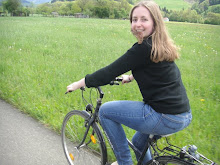
I seem to have far less time than I thought I would this summer, but at least I've had the chance to watch a lot of the World Cup. I was rooting for Germany and the US and now just Germany. My friends back in Freiburg tell me that the whole city goes crazy every time Germany wins, and based on what I saw last semester, I totally believe it. Whenever SC Freiburg or Bayern Munich played last semester, it seemed like every student in town was watching the game at one of the hundreds of bars broadcasting it. This wasn't unique to Germany, of course - I'm sure the fans are even more rabid in England, Italy, Spain, or any of the other traditional powerhouses.
One night last spring, I went with some friends to a local Italian place that sold spaghetti bolognese for 1.80 Euros between 6:00 and 7:30 pm. It was one of our favorite little cheap places to eat, but it would always be super crowded as everyone tried to take advantage of the spaghetti deal. That night we were there, I asked a man sitting alone at a table if we could sit with him (which is a totally normal social practice there). I asked in German and he responded in a strange combination of French and German. We were all a bit bewildered, but he was nodding enthusiastically so we sat down anyway. He then went on to explain, in the same mixture of French and German, that he was French but was in town for a while. We were struggling a bit with the muddled language, so he asked us what he spoke and informed us that he spoke French, some German, and some Spanish. We answered English and his eyes lit up before he started chattering away and asking us about "Arsenal." We had no idea what he was talking about, but as soon as we realized he was pointing to his FC Barcelona jersey, we understood that he thought we were British and was asking us if we supported Arsenal, a major team in the English Premier League. We all started laughing and explaining that we spoke English, but were actually just Americans studying abroad in Germany. He then laughed and asked us where we were from, and when I said California, he immediately began listing all the Californian cities he knew. When he got to San Diego, he said, "Mais San Diego ist wirklich in Mexiko, ja?" Big laughs all around as I, my three friends, and our new dinner pal enjoyed some delicious and cheap spaghetti.
The point I'm trying to make in this long-winded reminiscence is that football brings Europeans (and the world) together regardless of language. It would have been so easy for us to politely ignore our table-mate and speak only in English to each other so he couldn't understand us, but instead, we figured out where we were all from, what we were all doing in Freiburg, why we liked this restaurant (1.80 Euro spaghetti, of course) and which teams we supported in a strange mixture of French, German, English, "sign language", and even a word or two of Spanish. We all enjoyed our dinner and our talks, even if we sometimes didn't understand all of it. It sometimes only takes finding a little common ground to strike up a conversation, and in Europe, football seems to be a pretty good starting place.
I'm writing about football here not only because I want Germany to win the World Cup (I'm wearing a pair of shorts with German colors on them as we speak), but because it relates to some of the other themes I encountered while abroad. I had to interview my flatmates for a project for German class, and most of the questions were about patriotism, or "Patriotismus." When I asked two of them if and when they were proud of Germany, they both independently said "only during the World Cup." Most of my classmates got very similar answers from their flatmates, leading me to wonder why Germans are so hesitant to be patriotic. The short answer? Germany can't be patriotic with flags, glorious songs, and declarations of allegiance after Hitler and World War II. German nationalism is associated with too many horrific memories of the Third Reich, both for Germans and the rest of the world that witnessed that awful period of history. The long answer has more to do with the nature of patriotism in general, and I would never claim to be an expert on it, but my time in Freiburg really made me think about German patriotism, or the lack thereof, compared with American-style patriotism. I'm saving it for another post, but as long as everyone's waving their flags at the World Cup, I thought I'd put out a little introduction now. I'm sure our dinner friend is rooting for Spain, although maybe it was his homeland of France, or his neighbor Germany, or the object of his admiration, England...
Bis spaeter!
Monday, June 28, 2010

Saturday, June 19, 2010
One Month Later: The Things I Miss about Freiburg
The Least:
Dryers that never dried my clothes
Wearing clothes that didn't fit quite right after hang-drying all semester long
The badly designed laundry card system in my creepy-as-hell laundry room
No free water in restaurants
Paying for public restrooms
Germans' inability to form lines
Clothing stores that were generally too expensive
Customer service that was often very poor
Getting shot down while trying to speak German
Everything being closed on Sundays
The Most:
Being able to walk everywhere
Being able to bike EVERYWHERE
Great public transportation for lazy days
The eco-friendly lifestyle
The view of and proximity to the Schwarzwald
How beautiful the city was
Free entrance on students' nights at our favorite clubs
Bakeries on every street
Butterbrezeln
The national obsession with ice cream
The Münster and the Münstermarkt
Living the student life in a university town
Seepark
Paying with coins
Wurst for two euros
Fasnacht
The German language, both speaking it and getting utterly defeated by it
Historic architecture (even if it did have to be rebuilt after the war)
Rothaus beer
O'Kelly's Pub and Das Quiz
"Gehen wir in die Mensa?" "Ja, wir gehen immer in die Mensa!"
Proximity to France and Switzerland
My flatmates
My IES friends
Moments that started like this:

And ended like this:

Even a month later, I still can't believe it's over.
Dryers that never dried my clothes
Wearing clothes that didn't fit quite right after hang-drying all semester long
The badly designed laundry card system in my creepy-as-hell laundry room
No free water in restaurants
Paying for public restrooms
Germans' inability to form lines
Clothing stores that were generally too expensive
Customer service that was often very poor
Getting shot down while trying to speak German
Everything being closed on Sundays
The Most:
Being able to walk everywhere
Being able to bike EVERYWHERE
Great public transportation for lazy days
The eco-friendly lifestyle
The view of and proximity to the Schwarzwald
How beautiful the city was
Free entrance on students' nights at our favorite clubs
Bakeries on every street
Butterbrezeln
The national obsession with ice cream
The Münster and the Münstermarkt
Living the student life in a university town
Seepark
Paying with coins
Wurst for two euros
Fasnacht
The German language, both speaking it and getting utterly defeated by it
Historic architecture (even if it did have to be rebuilt after the war)
Rothaus beer
O'Kelly's Pub and Das Quiz
"Gehen wir in die Mensa?" "Ja, wir gehen immer in die Mensa!"
Proximity to France and Switzerland
My flatmates
My IES friends
Moments that started like this:

And ended like this:

Even a month later, I still can't believe it's over.
Sunday, June 13, 2010
"Freedom"
"Chomsky shows us how phrases like "free speech", the "free market", and the "free world" have little, if anything, to do with freedom. He shows us that, among the myriad freedoms claimed by the U.S. government are the freedom to murder, annihilate, and dominate other people. The freedom to finance and sponsor despots and dictators across the world. The freedom to train, arm, and shelter terrorists. The freedom to topple democratically elected governments. The freedom to amass and use weapons of mass destruction — chemical, biological, and nuclear. The freedom to go to war against any country whose government it disagrees with. And, most terrible of all, the freedom to commit these crimes against humanity in the name of "justice", in the name of "righteousness", in the name of "freedom"." - Arundhati Roy
I posted this quote because I've been thinking a lot about the word 'freedom' ever since Germany. I had a couple of good conversations with my flatmate about the way the government and media in the United States can use words with positive connotations, such as freedom, democracy, and justice, as justification for basically anything. I had never really thought in-depth about how ludicrous it is to use those types of words to describe acts of war. Over the past nine years, we've seen the "leader of the free world" engage in acts such as Operation Enduring Freedom (originally named Operation Infinite Justice) and Operation Iraqi Freedom. Where exactly does freedom come into these operations? One could argue, as the United States does, that the mission is to secure freedom and democracy where it doesn't exist, but it is freedom if a foreign power stages an invasion and asserts control, and if so, for whom? If we support the idea of a free market and Iraq just so happens to have oil, what kind of freedom are we actually seeking?
I think the term has become a deceptively nasty way to mask the horrors of war. When American citizens are constantly reminded to support the troops who are "fighting for your freedom," it becomes much easier to justify unilateral military action, invasions, civilian deaths, weapons of mass destruction, and the deaths of the poor soldiers themselves. First, the government convinces us that we want this vague ideal of freedom; then, it convinces us that the best way to achieve it is by waging war against our enemies abroad and against our civil liberties at home. It just astounds me how Americans can accept legislation like the PATRIOT Act or show support for racial profiling in the name of freedom, even though they both directly infringe upon our constitutional rights. The government's motive for using those kinds of terms is obvious, of course - it's so much easier to drum up support for ANY policy as long as the voting public believes it is just, free, and American. The part I can't believe is how incredibly detached we have become from the true meanings of the words we throw around. It is completely commonplace to see people protest gay marriage, abortion rights, and the idea of a Muslim president while simultaneously supporting the Iraq War, the use of corporate money in elections, and Arizona's draconian anti-immigrant laws, all in the name of freedom. That kind of "freedom" means nothing to me, and my conversations with my flatmate showed me how it often means nothing to the rest of the world either.
The mere fact that I can write this demonstrates some degree of real freedom, of course. My phone is probably not going to get wiretapped and I highly doubt I'll ever be brought in for questioning by the authorities. What's more likely, though, is that some people will accuse me of being "un-American" or that this blog will be used against me by an opponent if I ever run for office. Maybe that's the part that baffles me the most. If freedom is our country's ultimate ideal and the only thing I'm trying to do is promote REAL freedom, then why do people with similar views as me get vilified in the news or denounced as radicals? What's radical about protesting the government and media's misuse of a term that could mean so much, but has come to mean so little? I view dissent and debate as absolutely crucial in any effective civil society, and I think we come closer to true freedom when no one's views immediately get marked as anti-freedom or "anti-American." That phrase means even less to me than freedom does (although I suppose it means something to people like Rand Paul or Bill O'Reilly). There is nothing inherently American about the overarching concept of freedom, and I think the commonly accepted American version actually damages what the word is supposed to mean.
As a debater, I've encountered many cases about free speech and other civil liberties. One argument in particular often comes up, saying that no matter how vile, repulsive, or ridiculous a citizen's views might be, he or she should have a near-absolute legal right to express them. This allows people to march with the KKK or join the Westboro Baptist Church or believe that gay marriage is immoral. I agree with this argument completely, but not because I think the KKK has any worthy ideas. I agree because I think that dissent and debate will reveal and eventually eliminate the worst ideas and beliefs in society. Government doesn't need to intervene and it shouldn't have the right to do so. Blind acceptance of the word freedom or unfounded criticism of different political beliefs makes it easy to ridicule dissenters without actually thinking about what they have to say. This keeps bad ideas in circulation while preventing new ideas, whether good or bad, from entering the competition at all. That, I think, is dangerous for any society that gains its power from the people and their convictions.
All I want is for American citizens to truly think about the actions of our government without using the labels that have been pre-determined for us, making it possible to determine the validity of ideas, policies, and goals from a more neutral standpoint. This would, of course, be near-impossible with the strength of the mass media and our appetite for information. We certainly have to learn about policies somewhere, and nearly any source is going to have some degree of bias. I think we would at least be better off if we began to question the word freedom, which we hear so often without really hearing at all. Once we do that, I think we might come closer to recovering its true meaning, making it worthy of not only our respect, but the respect of the rest of the world.
I posted this quote because I've been thinking a lot about the word 'freedom' ever since Germany. I had a couple of good conversations with my flatmate about the way the government and media in the United States can use words with positive connotations, such as freedom, democracy, and justice, as justification for basically anything. I had never really thought in-depth about how ludicrous it is to use those types of words to describe acts of war. Over the past nine years, we've seen the "leader of the free world" engage in acts such as Operation Enduring Freedom (originally named Operation Infinite Justice) and Operation Iraqi Freedom. Where exactly does freedom come into these operations? One could argue, as the United States does, that the mission is to secure freedom and democracy where it doesn't exist, but it is freedom if a foreign power stages an invasion and asserts control, and if so, for whom? If we support the idea of a free market and Iraq just so happens to have oil, what kind of freedom are we actually seeking?
I think the term has become a deceptively nasty way to mask the horrors of war. When American citizens are constantly reminded to support the troops who are "fighting for your freedom," it becomes much easier to justify unilateral military action, invasions, civilian deaths, weapons of mass destruction, and the deaths of the poor soldiers themselves. First, the government convinces us that we want this vague ideal of freedom; then, it convinces us that the best way to achieve it is by waging war against our enemies abroad and against our civil liberties at home. It just astounds me how Americans can accept legislation like the PATRIOT Act or show support for racial profiling in the name of freedom, even though they both directly infringe upon our constitutional rights. The government's motive for using those kinds of terms is obvious, of course - it's so much easier to drum up support for ANY policy as long as the voting public believes it is just, free, and American. The part I can't believe is how incredibly detached we have become from the true meanings of the words we throw around. It is completely commonplace to see people protest gay marriage, abortion rights, and the idea of a Muslim president while simultaneously supporting the Iraq War, the use of corporate money in elections, and Arizona's draconian anti-immigrant laws, all in the name of freedom. That kind of "freedom" means nothing to me, and my conversations with my flatmate showed me how it often means nothing to the rest of the world either.
The mere fact that I can write this demonstrates some degree of real freedom, of course. My phone is probably not going to get wiretapped and I highly doubt I'll ever be brought in for questioning by the authorities. What's more likely, though, is that some people will accuse me of being "un-American" or that this blog will be used against me by an opponent if I ever run for office. Maybe that's the part that baffles me the most. If freedom is our country's ultimate ideal and the only thing I'm trying to do is promote REAL freedom, then why do people with similar views as me get vilified in the news or denounced as radicals? What's radical about protesting the government and media's misuse of a term that could mean so much, but has come to mean so little? I view dissent and debate as absolutely crucial in any effective civil society, and I think we come closer to true freedom when no one's views immediately get marked as anti-freedom or "anti-American." That phrase means even less to me than freedom does (although I suppose it means something to people like Rand Paul or Bill O'Reilly). There is nothing inherently American about the overarching concept of freedom, and I think the commonly accepted American version actually damages what the word is supposed to mean.
As a debater, I've encountered many cases about free speech and other civil liberties. One argument in particular often comes up, saying that no matter how vile, repulsive, or ridiculous a citizen's views might be, he or she should have a near-absolute legal right to express them. This allows people to march with the KKK or join the Westboro Baptist Church or believe that gay marriage is immoral. I agree with this argument completely, but not because I think the KKK has any worthy ideas. I agree because I think that dissent and debate will reveal and eventually eliminate the worst ideas and beliefs in society. Government doesn't need to intervene and it shouldn't have the right to do so. Blind acceptance of the word freedom or unfounded criticism of different political beliefs makes it easy to ridicule dissenters without actually thinking about what they have to say. This keeps bad ideas in circulation while preventing new ideas, whether good or bad, from entering the competition at all. That, I think, is dangerous for any society that gains its power from the people and their convictions.
All I want is for American citizens to truly think about the actions of our government without using the labels that have been pre-determined for us, making it possible to determine the validity of ideas, policies, and goals from a more neutral standpoint. This would, of course, be near-impossible with the strength of the mass media and our appetite for information. We certainly have to learn about policies somewhere, and nearly any source is going to have some degree of bias. I think we would at least be better off if we began to question the word freedom, which we hear so often without really hearing at all. Once we do that, I think we might come closer to recovering its true meaning, making it worthy of not only our respect, but the respect of the rest of the world.
Sunday, June 6, 2010
More to come...
Sorry for my long absence. I'm not sure if anyone is reading this blog anymore, but I still plan to post something about politics. It has just been busier than normal lately - I ended up making a trip to Boston and starting my internship right after. It's going great so far!
My semester in Germany really made me think about a lot of things, but surprisingly, it made me think about American politics more than I ever have in my life (even though I'm majoring in politics at school). I need to get my thoughts properly formulated before I can do justice to everything I've been mulling over - if you're still interested, just trust I will write it soon! I'm currently reading some books and articles that are helping me figure things out, but I'll try to write the post as soon as possible even if I don't finish reading right away.
For now, here's the link to my most recent photo album. It sums up the spring and the end of the semester in beautiful Freiburg.
http://www.facebook.com/album.php?aid=176752&id=599810215&l=bb68362a9c
Bis spaeter!
My semester in Germany really made me think about a lot of things, but surprisingly, it made me think about American politics more than I ever have in my life (even though I'm majoring in politics at school). I need to get my thoughts properly formulated before I can do justice to everything I've been mulling over - if you're still interested, just trust I will write it soon! I'm currently reading some books and articles that are helping me figure things out, but I'll try to write the post as soon as possible even if I don't finish reading right away.
For now, here's the link to my most recent photo album. It sums up the spring and the end of the semester in beautiful Freiburg.
http://www.facebook.com/album.php?aid=176752&id=599810215&l=bb68362a9c
Bis spaeter!
Sunday, May 23, 2010
Life in Germany
It is still strange to be home in the U.S., although it's been nearly a week now. I wouldn't say I'm having full-blown culture shock, but using dollars for the first time in five months blew my mind. I used five different currencies in Europe without a problem, but coming home and realizing that it's only going to be the dollar from now on was extremely strange. I also finally recognized just how big our American cars are. Everyone in the U.S. has heard about this for years, of course, but it really takes being away for a while to see how excessive some of those SUVs are. I can't think of one good reason for a family of four to own a Hummer, but I've seen at least two average-looking people driving them down the freeway. A Hummer, I think, is the sure sign of excess in a country criticized for overconsumption.
I think it would be useful to sum up my student life in Germany, especially if anyone reading this blog is interested in visiting or living there. I'm still formulating my political post because I've been doing quite a bit of thinking about it, and that will have to come at a later point. For now, I'll just break everything down into categories for the sake of simplicity. These are the issues that I thought about the most as a student.
Transportation: Germany wins here, hands down. Public transportation was fantastic in Germany, especially in my beloved Freiburg. The tram system was always clean, well-organized, on-time, and relatively cheap, especially with a monthly pass. It was also easy to figure out with a good website that had an English option in case the German was too confusing. I could get nearly anywhere I wanted in Freiburg with ease, although I didn't use the system more than once or twice after I bought my bike in April. The German train system, the Deutsche Bahn, was also great. It could not be easier to book tickets online, there are always good discounts if you know where to look, and it offers special deals like the Schoenes-Wochenende ticket that I've mentioned on this blog before. The trains are modern, fast, clean, and quiet, and the train stations are easy to navigate and well-marked, even in the small towns. Even with a bit of a language barrier, I found the Deutsche Bahn far easier to navigate than Caltrain, which I barely ever use and for good reason. Not only does taking Caltrain necessitate a 30-minute drive to Palo Alto, it just doesn't cover the same amount of ground and with the same efficiency. Trying to figure out public transportation in San Francisco is a hassle, especially if you need to use the subway AND above-ground transportation. Boston is quite a bit easier and has an excellent subway system, but the quality of the experience on its slow and old trains pales in comparison to my experiences in Germany. Finally, Germany is much more bike-friendly, especially in a green city like Freiburg. The bike lanes were always wide and well-marked, bike racks are available EVERYWHERE, and bike stores and repair shops are easy and accessible. I loved walking or biking around Freiburg and seeing people getting their groceries or running errands on a bike rather than in a car. This also has to do with city layouts - you don't see much of that suburban sprawl like we have in California where you really need a car to get to where you need to be. In Freiburg, all the main stores and establishments were downtown and easily accessible by subway, foot, or bike. Now that I'm home in rural La Honda, I really miss the ease of transport.
Food: The food in Germany was one of the highlights of my experience. Not only did I get the chance to try traditional specialties like Spargel, I got to enjoy the benefits of a country that just prizes food. Food and mealtimes are special in Germany, and you'd never see kids wolfing down TV dinners or parents buying Costco-sized bread rolls. Instead, families eat together, choose seasonal produce, buy fresh bread nearly every day, shun artificial ingredients, and generally relish eating as an experience. It wasn't hard for me to get into that - I could access high-quality produce, dairy products, and meats at my local grocery store for excellent prices. Sometimes I'd be thinking, "Oh, I've picked out a full basket of items, most of which are local or organic - I'd better break out the 50 Euro note" only to reach the line and face a bill of 15 Euros. Then, on the way out, I could stop by the bakery above the grocery store and get some fresh Brezeln or bread for a Euro or two. I could also access the farmers' market nearly every day, which was a truly great way to get any kind of vegetable or fruit I wanted. I've been fortunate enough to eat high-quality food and produce in the U.S. as well, but I think there is still a distinction in the eating cultures. You'd never see Germans do the Atkins diet - they're much thinner than we are as a whole, but if they want to lose weight, they'll exercise more and cut down on treats. Bread is an essential part of the German diet, and the Germans aren't willing to cut traditions or their way of life just to cut pounds. It was so nice and refreshing to live in a place that views food as something to be cherished rather than as something to be controlled.
Environment: I already knew that Freiburg is a green city (and is in fact the only city in Germany with a Green mayor), but I was still very impressed with how environmentally conscious everybody was. EVERYBODY recycles into five or six different categories, windmills grace the hills around the city, people bike or walk as much as possible, solar panel usage abounds, and nearly all new buildings must reach tough energy efficiency standards. This is true for much of Germany, but especially for Freiburg. The car-free neighborhood of Vauban is hyper-conscious about the environment - not only do most houses have solar panels and/or passive energy constructions, it costs 18 thousand Euros to park your car. Effective disincentive right there, I think! Environmental consciousness isn't casually dismissed as unrealistic or a luxury problem like it is the U.S. - EVERYONE can play a part, whether it's sorting through trash into the appropriate receptacles or buying an expensive passive house in Vauban. It's no secret that the U.S. lags far, far behind Europe in energy efficiency and surges way ahead in oil usage and emissions levels. No contest in this category.
Friendliness: I had heard lots of stereotypes about hostile Germans before I got here, but fortunately, they were wrong for me. It's true that Germans won't walk around and smile at every person they see, throw out a casual "how are you" out of habit, or say "we should hang out sometime!" just to be polite. What they will do, though, is enthusiastically greet their friends and acquaintances and really mean it when they ask how they are. Their friends will respond with a honest assessment of how they are rather than "I'm fine, and you?" If a German says "we should hang out," it means you'd better get out your calendar, set a firm date and time, and genuinely want to keep the meeting. If you don't feel like hanging out at a particular time, there's no need to do the old "Oh I'm so sorry, I really would, but I already promised I would do X on that day..." It's considered okay and non-offensive if you just don't feel like it. In many ways, I think Germans are friendlier than Americans. Americans will be aggressively cheery towards each other, but with a good deal of fakeness. Germans are more genuine, and at the same time, nice to strangers. I've asked for help with directions or whatever many times and every single person I asked was more than happy to help me out. I'm happy to say that this particular stereotype was debunked during my experience.
Education: Unlike in the U.S., nearly all of Germany's universities are public. The point I want to focus on is the vast difference in cost for German students versus American students. Students at public schools in the U.S. will pay at LEAST several thousand dollars per semester and usually more, while students at private schools encounter costs as high as $55,000 per year. Every time I told Germans this, their jaws dropped. They absolutely could not imagine how or why anyone could pay that much, even if they had enough money to easily do so. In Germany, tuition was banned until 2005 when states won the right to charge student fees. Even now, the states that have exercised this right (including Baden-Wuerttemberg, where Freiburg is) don't charge more than about 550 Euros per semester. While there are some other costs for students that can add up to a few thousand Euros, studying at the most expensive German university will still cost less than studying at the cheapest American state schools. When the 500-Euro fees were introduced at some German universities in 2007, students took to the streets in protest. They viewed the imposition of fees as an abridgment of their fundamental right to education. The charges would, in fact, make university prohibitively expensive for many students, effectively preventing them from exercising their rights under German law. The U.S. considers education a right until at least the 12th grade, but the more time I spent in Germany, the more I wondered why that right should suddenly cease after high school. True, we have federal financial aid, but the neediest families aren't going to find a measly $4,000 Pell Grant enough to cover even one semester at an average public school. Rather, too many students and families will find themselves drowning in debt after only a few years. German students aren't even familiar with the concept of student loan debt and would shake their heads in disbelief when I talked about it. I believe there should be as few financial obstacles as possible on the road to public higher education, and not because I think it would be a piece of cake to offer a fully funded education to all students at the college of their choice. Rather, the U.S. has a compelling interest in facilitating the university education of as many students as possible. Our economy and civil society would no doubt be better off if, like Germany, we truly viewed education as an investment rather than a cost.
This post came out a bit longer than I intended, so I'll cover a few more categories later on to avoid cramming everything into a monster post. I'll be offline for a few days, so bis spaeter!
I think it would be useful to sum up my student life in Germany, especially if anyone reading this blog is interested in visiting or living there. I'm still formulating my political post because I've been doing quite a bit of thinking about it, and that will have to come at a later point. For now, I'll just break everything down into categories for the sake of simplicity. These are the issues that I thought about the most as a student.
Transportation: Germany wins here, hands down. Public transportation was fantastic in Germany, especially in my beloved Freiburg. The tram system was always clean, well-organized, on-time, and relatively cheap, especially with a monthly pass. It was also easy to figure out with a good website that had an English option in case the German was too confusing. I could get nearly anywhere I wanted in Freiburg with ease, although I didn't use the system more than once or twice after I bought my bike in April. The German train system, the Deutsche Bahn, was also great. It could not be easier to book tickets online, there are always good discounts if you know where to look, and it offers special deals like the Schoenes-Wochenende ticket that I've mentioned on this blog before. The trains are modern, fast, clean, and quiet, and the train stations are easy to navigate and well-marked, even in the small towns. Even with a bit of a language barrier, I found the Deutsche Bahn far easier to navigate than Caltrain, which I barely ever use and for good reason. Not only does taking Caltrain necessitate a 30-minute drive to Palo Alto, it just doesn't cover the same amount of ground and with the same efficiency. Trying to figure out public transportation in San Francisco is a hassle, especially if you need to use the subway AND above-ground transportation. Boston is quite a bit easier and has an excellent subway system, but the quality of the experience on its slow and old trains pales in comparison to my experiences in Germany. Finally, Germany is much more bike-friendly, especially in a green city like Freiburg. The bike lanes were always wide and well-marked, bike racks are available EVERYWHERE, and bike stores and repair shops are easy and accessible. I loved walking or biking around Freiburg and seeing people getting their groceries or running errands on a bike rather than in a car. This also has to do with city layouts - you don't see much of that suburban sprawl like we have in California where you really need a car to get to where you need to be. In Freiburg, all the main stores and establishments were downtown and easily accessible by subway, foot, or bike. Now that I'm home in rural La Honda, I really miss the ease of transport.
Food: The food in Germany was one of the highlights of my experience. Not only did I get the chance to try traditional specialties like Spargel, I got to enjoy the benefits of a country that just prizes food. Food and mealtimes are special in Germany, and you'd never see kids wolfing down TV dinners or parents buying Costco-sized bread rolls. Instead, families eat together, choose seasonal produce, buy fresh bread nearly every day, shun artificial ingredients, and generally relish eating as an experience. It wasn't hard for me to get into that - I could access high-quality produce, dairy products, and meats at my local grocery store for excellent prices. Sometimes I'd be thinking, "Oh, I've picked out a full basket of items, most of which are local or organic - I'd better break out the 50 Euro note" only to reach the line and face a bill of 15 Euros. Then, on the way out, I could stop by the bakery above the grocery store and get some fresh Brezeln or bread for a Euro or two. I could also access the farmers' market nearly every day, which was a truly great way to get any kind of vegetable or fruit I wanted. I've been fortunate enough to eat high-quality food and produce in the U.S. as well, but I think there is still a distinction in the eating cultures. You'd never see Germans do the Atkins diet - they're much thinner than we are as a whole, but if they want to lose weight, they'll exercise more and cut down on treats. Bread is an essential part of the German diet, and the Germans aren't willing to cut traditions or their way of life just to cut pounds. It was so nice and refreshing to live in a place that views food as something to be cherished rather than as something to be controlled.
Environment: I already knew that Freiburg is a green city (and is in fact the only city in Germany with a Green mayor), but I was still very impressed with how environmentally conscious everybody was. EVERYBODY recycles into five or six different categories, windmills grace the hills around the city, people bike or walk as much as possible, solar panel usage abounds, and nearly all new buildings must reach tough energy efficiency standards. This is true for much of Germany, but especially for Freiburg. The car-free neighborhood of Vauban is hyper-conscious about the environment - not only do most houses have solar panels and/or passive energy constructions, it costs 18 thousand Euros to park your car. Effective disincentive right there, I think! Environmental consciousness isn't casually dismissed as unrealistic or a luxury problem like it is the U.S. - EVERYONE can play a part, whether it's sorting through trash into the appropriate receptacles or buying an expensive passive house in Vauban. It's no secret that the U.S. lags far, far behind Europe in energy efficiency and surges way ahead in oil usage and emissions levels. No contest in this category.
Friendliness: I had heard lots of stereotypes about hostile Germans before I got here, but fortunately, they were wrong for me. It's true that Germans won't walk around and smile at every person they see, throw out a casual "how are you" out of habit, or say "we should hang out sometime!" just to be polite. What they will do, though, is enthusiastically greet their friends and acquaintances and really mean it when they ask how they are. Their friends will respond with a honest assessment of how they are rather than "I'm fine, and you?" If a German says "we should hang out," it means you'd better get out your calendar, set a firm date and time, and genuinely want to keep the meeting. If you don't feel like hanging out at a particular time, there's no need to do the old "Oh I'm so sorry, I really would, but I already promised I would do X on that day..." It's considered okay and non-offensive if you just don't feel like it. In many ways, I think Germans are friendlier than Americans. Americans will be aggressively cheery towards each other, but with a good deal of fakeness. Germans are more genuine, and at the same time, nice to strangers. I've asked for help with directions or whatever many times and every single person I asked was more than happy to help me out. I'm happy to say that this particular stereotype was debunked during my experience.
Education: Unlike in the U.S., nearly all of Germany's universities are public. The point I want to focus on is the vast difference in cost for German students versus American students. Students at public schools in the U.S. will pay at LEAST several thousand dollars per semester and usually more, while students at private schools encounter costs as high as $55,000 per year. Every time I told Germans this, their jaws dropped. They absolutely could not imagine how or why anyone could pay that much, even if they had enough money to easily do so. In Germany, tuition was banned until 2005 when states won the right to charge student fees. Even now, the states that have exercised this right (including Baden-Wuerttemberg, where Freiburg is) don't charge more than about 550 Euros per semester. While there are some other costs for students that can add up to a few thousand Euros, studying at the most expensive German university will still cost less than studying at the cheapest American state schools. When the 500-Euro fees were introduced at some German universities in 2007, students took to the streets in protest. They viewed the imposition of fees as an abridgment of their fundamental right to education. The charges would, in fact, make university prohibitively expensive for many students, effectively preventing them from exercising their rights under German law. The U.S. considers education a right until at least the 12th grade, but the more time I spent in Germany, the more I wondered why that right should suddenly cease after high school. True, we have federal financial aid, but the neediest families aren't going to find a measly $4,000 Pell Grant enough to cover even one semester at an average public school. Rather, too many students and families will find themselves drowning in debt after only a few years. German students aren't even familiar with the concept of student loan debt and would shake their heads in disbelief when I talked about it. I believe there should be as few financial obstacles as possible on the road to public higher education, and not because I think it would be a piece of cake to offer a fully funded education to all students at the college of their choice. Rather, the U.S. has a compelling interest in facilitating the university education of as many students as possible. Our economy and civil society would no doubt be better off if, like Germany, we truly viewed education as an investment rather than a cost.
This post came out a bit longer than I intended, so I'll cover a few more categories later on to avoid cramming everything into a monster post. I'll be offline for a few days, so bis spaeter!
Wednesday, May 19, 2010
Reflections
Days Abroad: 126
Countries Visited: 10
Cities Visited: 21
Languages "Spoken": 9
Currencies Used: 5
Currencies Used: 5
Pictures Taken: at least 2,000
IES Students: 61
Flatmates: 6
Bad Experiences: 0
I'll use this post to update everyone on some of the activities I did since my last post as well as provide some sort of overarching perspective on the whole experience. It's going to be a bit long, so consider yourself warned! After my bike ride with Mike that I wrote about, I became extremely busy. Not only were there lots of final papers to write and finals to study for, it was our last week in Freiburg and we wanted to live it up. I'm glad to say that we finished all of our work and had an incredible last week at the same time.
Last Monday, we went to Das Quiz one final time and enjoyed some beers and a 21st-place finish. It was amazing how people of all different stripes would come to this Irish pub in Freiburg every single week, completely committed to playing an English-German quiz game. Looking back, I consider those nights as highlights of my experience, and I wish I had gone every single week. We ended up going back there the next night just to hang out and enjoy each other's company. Even though we all had tons of finals, we rallied so we could have a great final week.
The next day, Wednesday, was also a highlight. It was the first sunny day in a long stretch of rainy days and we decided to take advantage of it. My good friend and I went on a bike ride around Freiburg and into the neighboring town of Kirchzarten. Luckily, he was able to borrow a bike from our other friend. It was absolutely beautiful with all the flowers in bloom and the green hills of the Black Forest. We came back by the soccer stadium and down the river, which is an especially beautiful area of Freiburg. We went about 25 kilometers in total - not too shabby, I think!

On the stretch to Kirchzarten

What a truly beautiful city
Wednesday night was also great. My flat had decided to cook dinner together to wish me farewell and to welcome our new roommate (a girl!) who moved in the day before. "Cook together" is a bit of a stretch, though - instead, Johannes cooked us a German feast while we provided drinks and a few Euros for the food. The result was a delicious (and nearly 100% organic) meal of traditional potato soup, Frikadellen (German meat patties, similar to meatballs), mashed potatoes, red cabbage, and homemade tiramisu. The food was absolutely amazing and we had a great time with everybody there together. After dinner, we played a few rounds of UNO and then went to a party next door that my friend was hosting. It was so much fun to go out with the whole flat at once.

Our flat! We're incapable of taking pictures where everybody looks good, so this will have to do. It was interesting not to be the only girl for the first time all semester.
I spent most of the day on Thursday trying to get work done before the opening ceremony for Model EU. I know I haven't really mentioned that before, so I'll start here. Every semester, IES puts on a Model EU conferences that takes place over three days. All the students act as either Heads of State or Foreign Ministers for each country in the EU, but a couple of people assume leadership roles such as the High Representative as well. I was the Foreign Minister for the UK, which is a role that allows for a bit of fun. The UK is known for being Euroskeptic, which is only more true given the recent change of government from Labour to a Tory-Lib Dem coalition. At the same time, the UK is a major influential player in European Union policy. We all got dressed up in our business clothes and went to the opening ceremony at IES on Tuesday night. That wasn't what we were really looking forward to, though - back in early April, the central IES Study Abroad office announced a contest to see which IES location could get the most votes for the best study abroad program. Our program director, lovingly known as Ulli, told us that if we made it to quarterfinals, he'd take all 61 of us out for cocktails at Kagan, one of the trendiest clubs in town. The entire group cheered upon hearing that, but I don't think Ulli realized how serious we were about to get. We all voted right away, got family, friends, and flatmates to vote, and dominated our way not just to quarterfinals, but all the way to finals! Unfortunately, the final voting period coincided with our program being stranded all over Europe without Internet access during the volcano drama. I'm convinced we would have won if we had Internet, especially since we only lost by 100 votes. Regardless, we earned our cocktails and headed to Kagan as a massive group shortly after the Model EU opening. Kagan is a great club on the top two floors of one of the tallest buildings in Freiburg. This means it had a great view of the entire city and the Black Forest. It was so much fun to enjoy free cocktails with all of our program, including most of the teachers. Nothing like seeing middle-aged Germans let their hair down, right? Afterwards, most of us stayed to enjoy some dancing before having to wake up early for the first real day of Model EU.
Model EU was pretty fun. We debated issues that are especially important in EU foreign policy, notably Afghanistan, illegal immigration, and anti-terrorism intelligence efforts. The downside was that we had to sit in the two rooms for eight hours a day, which was especially difficult for some people who had partied a little too hard the night before. Regardless, we had a good time pretending to be important on the global stage. Several different people came up to me afterwards and said how impressed they were with my debate skills, which made me really relieved! I was afraid I'd lose it all after leaving the debate team for a semester. On the last night, Saturday, we wrapped it up, took a few hours off to relax, and then people came to my place to hang out for a few hours.
Sunday was a bit exhausting because those of us in the highest-level EU seminar class had a massive paper to write for Monday morning. There was also the added pressure of having to get work done before leaving for the IES farewell dinner in a neighboring town. I worked relatively productively given my lack of sleep for the last week and then headed to the dinner. We went to a dairy farm in the nearby town of Hinterzarten. The walk up to the barn was really nice and pretty, especially since we ran into some friendly Scottish Highlander cows that came close to us/tried to lick me. It was an interesting choice for a final dinner, but it was great all the same! We took a short tour of the dairy farm led by the head guy who spoke no English. He had a translator, but I'm happy to say I didn't need one! At least I haven't forgotten all of my German yet. After the tour, we headed into the barn to eat. The food was basically tray after tray of meat products and homemade cheese (i.e. DELICIOUS). It was nice to wrap up the semester with an original and quintessentially southern German experience.

I wanted to take this one home.

My plate and one of my favorite local beers
Monday was both a fun and incredibly challenging day. The weather was really nice and most of us finished our essays on time, but the knowledge that this was the last day really weighed heavily on me. Even still, I tried to enjoy it as much as possible without being sad. We finally made it to the top of the Freiburg Muenster (the main cathedral), which we'd been intending to do all semester! The view was great and we had lots of fun trying to take a picture of the whole group with the self-timer. This was the best we came up with:

We could not possibly have been more American/had more fun.
We all headed back to our rooms to pack in the afternoon. I picked up a few things from the grocery store to bring home before getting started. Packing wasn't as bad as it is at Brandeis since I really didn't bring all that much stuff with me. I took a break for a few hours to have one final beer with one of my favorite flatmates. I'll have more to say about him and the conversations we've had in a later post. That night, I went out with some friends to a local restaurant and finally had some of that famous German Spargel (white asparagus) prepared in the traditional way. It was absolutely delicious and the perfect way to wrap up the culinary element of the semester. Afterwards, we met up with most of the other students in IES at one of our favorite bars to say goodbye. We enjoyed hanging out there for a few hours, although we were quite a spectacle by the end as many of us (including me) started crying. The prospect of saying goodbye to all the people that we've spent nearly every moment with for the past five months was just overwhelming. It took nearly half an hour to say goodbye to everyone when we finally decided to leave.
Luckily, I didn't have to say goodbye to EVERYONE at once since quite a few of us would be taking the same train to the airport the next morning. I checked out of room pretty early and said goodbye to my flatmates before heading over. It really sucked to say goodbye to them. Some people in IES never became friends with their flatmates, but I was really close with two of mine and pretty close with the others as well (even our new one who just moved in the week before). It's hard to believe that I won't be able to sit in the kitchen and chat in German or English with them while sharing beers and food together. The simple pleasures in life have always been the best for me and I'm so sad to leave the good times in my flat behind.
The train ride was relatively uneventful. One of my best friends helped me get my stuff there (he's not leaving Freiburg until June) and it sucked to say goodbye to him, but I tried to focus on getting my two heavy bags on and off the train without knocking people over. Most of the people on the train were on the same flight to Chicago, but I had another best friend with a flight to D.C. around the same time as mine. After we said another tearful goodbye to the others, we headed to our terminal and spent the last few hours eating chips and trying not to focus on how hard it would be to say goodbye to each other. We had spent so much time with each other and with the other friends in our close-knit group, which was fantastic all semester but so hard when it came time to leave. I somehow survived that final farewell with her and boarded my 12-hour flight back to San Francisco. The flight was utterly depressing, but there was no way to avoid that (especially given the super cramped economy seats nowadays).
So, I guess I've basically finished summing up everything I did this semester. I absolutely cannot believe it's over. I have honestly never had a better time in my entire life, and if the biggest complaint I have about Germany is that the dryers in my apartment building didn't work right, then I consider my semester there a huge success. I plan to write another post soon comparing life in Germany to life in the U.S. now that I've experienced both. It will also contain some reflections on politics and how my political views have evolved as a result of my observations and conversations with Germans.
All in all, it is incredibly hard to be home right now. I'm happy to see my family, but the change is already so drastic. I had to stop myself from doing things that have become so routine, such as saying goodnight, good morning, and goodbye in German. Even though my flatmates and I spoke English to each other quite a bit, we ALWAYS said those three things in German. I miss the sounds of people walking in the hall in my flat and knowing who was there based on whether they were walking fast or slow or whistling or not. I hope it'll get easier eventually, but it's certainly a struggle right now. I know some people are able to look back on all the happy memories and leave it at that, but I don't feel like I can do that because I'm not done with Freiburg yet. I don't know if I will ever be. Even if I never go back, though, at least I know that I have been so lucky to have such a wonderful experience. Thanks for reading this blog throughout the semester - there will be more posts soon! As usual, bis spaeter.
Saturday, May 15, 2010
I'm Still Here
This is just a brief update to let everyone know I have not forgotten about my blog in the final days in Freiburg. As soon as I get home to California, I'll write much more to let you all know how things are going. Despite the lingering final essay I must complete, we've all been having so much fun. Talk to you soon and wish me luck on the way home!
Subscribe to:
Posts (Atom)